




















|
|
|
|
|
|
|
|
|
|
|
|
|
|
|
|||||||||||
|
|
|
||||||||||
|
|
|
|
|
|
|
|
|
|
|
|
|
|
|
|
|
|
|
|||||||
|
|
|||||||||||
|
Ecology Section ----- R. Frozen Regions We're on a moving train. We now live on a runaway planet. Beyond our own human production of greenhouse gases, we're in the beginning stages of an exponentially accelerating set of feedback loops: 1. Our polar regions now have amazingly warm summer weather. The Arctic's permafrost is thawing. If 100% of the Arctic's permafrost thaws, 1.7 trillion tons of greenhouse gases will be released into the atmosphere. Atmospheric greenhouse gas levels will nearly triple from 425 ppm. We can estimate our remaining timetable -- Yale360 estimated on 1/21/20 that 20% of the permafrost will melt by 2040. A reasonable number of research tunnels have been cut down into the permafrost in various countries, and reports are that all of them are slowly dripping melted water. Bottom line, we're all going to feel regret soon enough that we didn't stop the planetary thaw-out. Temperate zones are also experiencing less days of snow cover, which changes the region's average annual reflective albedo from more snow white to more dark, and in a study performed in eastern Massachusetts this absence was causing a slow release of extra greenhouse gases from temperate climate soil. 2. The Western U.S. and many other areas of the planet are experiencing megadroughts. Multi-decade megadroughts are characterized by overall loss of natural vegetation on a grand scale, by runaway insect plagues, by megafires and by a massive acreage of tree deaths from unprecedented summer high temperature and low humidity events. Bare topsoil underneath billions of dead trees can quickly become bone-dry in summer. Extended periods of bone-dry soils in summer can lead to ultra-low humidity and record high temperatures. Climate researcher Christopher Haines and others are concerned that most current urban landscapes and plowed fields also exacerbate regional extreme heating events. For further reading: https://insideclimatenews.org/news/02092022/study-finds-that-mississippi-river-basin-could-be-in-an-extreme-heat-belt-in-30-years/ Beyond these two critical feedback loops are many serious climate effects. A massive extinction of species is underway. We'd be smart to put a vast number of species into extinction zoos. Our world's coasts can see 200 mph typhoons on top of sea level rise. The American Midwest is seeing town-busting wedge tornadoes. As an inventor I assume that humanity can develop hardened building codes for some of this new reality, not that we'll like it. This ecology section of web pages is especially concerned with the following goals: We seek net carbon sequestration, not a break-even policy. We're now on a moving train. We seek retention of water within the topsoil and also in traditional mountain glaciers and late spring snow pack. We seek a lowering of air temperatures. Changing solar heat into transpiration or evaporation is usually better for the regional climate than letting the sun heat the bare ground or the bare concrete. R1. Frozen ecology “Albedo” refers to the reflectivity of a part of the earth. A high albedo means that a high proportion of sunlight is reflected back into space. Fresh snow has a high albedo. We're on track to have an Arctic disaster. We're now looking at spectacularly hot Arctic summers relative to perhaps 50 years ago. The most direct cause of this overheating is a reduction in the Arctic's spring and summer albedo from snow white to either blue on the Arctic Ocean or brownish on the tundra. Also, without snow the tundra is bone-dry. After millions of years of torpor, the tundra is catching fire. Tundra megafires are even surviving the Arctic winters -- they can spring back to life in spring after surviving deep under the soil all winter. The loss of Arctic ice has been suggested as one cause for the megadrought and megafires in the western U.S. See: cleantechnica.com/2022/01/03/fire-ice-the-puzzling-link-between-western-wildfires-arctic-sea-ice/?utm_campaign=The%20UnEarth%20Bulletin&utm_medium=email&utm_source=Revue%20newsletter All parts of the earth and the oceans are absorbing more heat these days, and then they're losing heat more slowly at night. Nowhere is regional heat absorption more dramatic than in cold regions that once were white and ice-covered, or that used to be covered with snow for a greater portion of the year. The Arctic Ocean and the tundra have become relatively ice-free and hot these days. Temperature changes in nearby boreal, frost belt and mountainous regions aren't as dramatic but we should still be honest about heat absorption - we're going to miss the snow cover. We face the numbers or we all suffer. When suffering goes around it tends to come all the way around. For further reading: Across the Boreal Forest, Scientists Are Tracking Warming’s Toll. Researchers are studying dramatic changes in the vast northern forests: thawing permafrost, drowned trees, methane releases, increased wildfires, and the slow transformation from carbon sinks to carbon emitters. Human civilization must plan and engineer for this reality or else we will continue to see worse results. In my opinion, almost zero worldwide R&D effort is being productively put into avoiding a disastrous end. Planners probably aren't thinking at all about the permafrost release alternatives described on this web page. Either the lot of us have chosen a path of much suffering, hunger and death by default or else at least a few of us have chosen to pursue potent R&D paths. A city has its fire department put out a forest fire before it burns down the city. Waiting until 20% of the city is afire doesn't make sense. A wise coalition of nations will inhibit the Arctic thaw-out well before the catastrophe picks up momentum. R2. Flaring Arctic methane
We need a spark. A relatively small photocell will work for 8 months of the year in the Arctic. The sparker wouldn't be able to flare in November but it would work for most of the year. A wind-powered alternative would be a little computer fan blade to catch wind energy for sparking. Naturally, the system needs a battery for dark periods. Millions of these flaring devices would have to be installed in muck and in tiny ponds. I visualize drone delivery or midwinter delivery because wading through deep muck is problematic. We also need methane-detecting cameras on the radio-controlled drones. We want lightweight devices. I recommend devices with sponges that absorb and keep great amounts of local pond water to hold them in place in extreme winds, and with floats. For ponds, the system needs a tiny anchor that drops into the muck at the bottom of the pond. Certain precise spots are yielding much of the methane. It's best if the system captures and concentrates methane bubbling up through a pond's surface or through muck. I visualize a collection bag in the middle of a flexible hoop of sponges. The collection bag can lay on the pond's surface – the methane will still make its way to the collection bag's pipe. The pipe has a well-insulated throat. Methane won't burn below the pipe's throat, but the metal throat stays hot from burning methane so that flaring is constant even when sparking doesn't take place. ------------------------------------------------------------------------------ R3. Enhancing winter sea ice formation with seawater pumps 8/10/26 Excuse me as this invention evolves. The polar ocean pipe has to perform the following functions: - it must float upright, given little wind. Usually buoys will have ballast at the bottom and floatation chambers. - It must have a wind turbine/pump at its top. - Sections of the pipe must freeze into place or thaw away from adjoining ice as needed. - It must have a way of being grappled from above by a drone. - It must pump water above the current ice pack on demand. Sometimes, in the beginning, very little ice needs to be pumped. In practice I expect that the drones or a ship would plant the pipes perhaps every 200 meters in an east-west line, about 200 meters south of the previous line of pipes in the Arctic. The pipes will grow fairly flat ice volcanoes perhaps 6 meters high at their tops, at the pipe, and 5 meters thick at their edges. The pipes will typically start their work in water that contains enough pancake ice that the pipes stay where they are planted, like a row crop. Ice formation typically starts when the air temperature is -10 degrees Celsius or below. The first few iterations are mere squeezes from roughly the bottom of the pipe to about ten centimeters above the pipe's floatation line This grows a rime of ice outward from the surface of the pipe. Inside the pipe the water is kept warm enough, if necessary, to prevent the pipe from freezing inside. If the water exits the pipe at 11 centimeters above the pope's floatation line then it flows down the sides of the pipe to create an ice cylinder. Ice typically has 9/10 of the mass of water for a given volume of ice/water. This ice cylinder drags the pipe downward. At some point the accumulating layers of ice are just pumping back into the ocean water with little freezing. At this point the pump turns on a heating coil that warms the pipe section nearest its waterline, freeing the pipe from its cylinder. The cylinder slides about 9 centimeters down the pipe and the pipe slides up to its typical waterline. Then this particular heating coil is turned off. The pipe once again freezes solidly to its cylinder of ice. Pumping commences again, always just enough to coat the above-surface ice with a thin layer of water like a Zamboni on an ice rink. The edge of the ice cylinder is also picking up occasional wavelets that coat the ice with salt water and then recede. As the cylinder grows wider, pumped water tries to flow where it can. It may often start little dams of ice on its surface, with pools of water forming closer to the pump. The near-freezing water freezes most effectively on the lip of its ice circle, growing the lip of this circle upwards. Excessively warm ocean water may cut a channel through one of these ice dams, and then a further away circular ice dam will form on the growing ice pack. At some point the growing ice cylinder starts to bond with one or more floating pieces of nearby ice. This expands the growing ice cylinder onto the new piece of ice. Through successive meltings and refreezings, the bottom of the growing ice cylinder grows downward into the sea with a shape like an inverted volcano. After the ice cylinder/volcano shape gets at least one meter deep, the top of the pump is pumping water upwards out of the pump's release point 10 centimeters above the water line, into a pool surrounding the pipe. The relatively warm water can cut its way through the landscape of fresh water ice, outward to the point where it starts to freeze. At this point a series of ice dams forms. The water meanders away from the center like a river delta, regularly cutting through the old pond ice walls and sometimes cutting channels, then forming new pond ice walls further away from the pump in the center of the ice cylinder. If the ice cylinder grabs onto a chunk of pancake ice, sometimes that ice streem will jump onto that pancake ice ans start adding to its bulk. At times the thickened nearby pancake ice may break off again from the stresses of the main cylinder sinking 9 cm at a time. Soon enough, the freezing water will once again seal the crack between the central cylinder and the thickened pancake ice chunk. As the cylinder expands, the central pump needs to recognize this expansion and put out more substantioal pulses of water. The water will travel farther and farther across the ever-expanding cylinder, coating the cylinder with a light freezing layer of water. We eventually want the water to flow 100 meters away to the place withere this ice volcano meets the neighboring ice volcanoes. At this point the seawater flooding the top of the ice can seek out low points on the now solid ice, filling in those low spots and sealing any cracks in the ice. My target is 5 meters of ice across the entire area. If ice is expected to be 5 meters deep then we must expect to pump 0.5 meters upward from the floating pump's waterline. the bottom of the pump's wind turbine roator needs to be at least .6 meters above the waterline. We can leave open spots where Arctic seals can in time create their own airholes in winter. . If the ice extends at leat 5 meters below the waterline then we need a 5 meter heating wire that extends below the bottom of the pipe. Otherwise we won't have a path for ocean water to reach the bottom of the pipe/pump.. Finally the pipe melts itself free. Then a drone airlifts the pipe straight up. If the pipe/pump is in good shape the drone drops it in a new spot to grow more icwe. Badpipes go back to a ship or to a nearby island for refurbishment. If we don't have enough new ice to hold the pipes in place, perhaps we could have misting buoys spriing water as mist into the local air. The misters will cool the local water driplets. A later of ice crystals will form on the ocean's surface, enouh to hold te pipes int their places. . - - - - -
I see the carrying ship plowing furrows through newly frozen 1 cm to 10 cm ice. It drops the pipes off of its stern like a crop, or it can reach way out and drop them straight down through fresh untouched ice. Drones can also do this job. Only drones can pick up the self-melting pipes from their icebergs and/or new ice walls. The units really need to be checked out onboard the ship before redeployment. 11/22/25 This pump is getting cheaper to produce. It's becoming a pipe roughly 3 meters tall and 10 centimeters in diameter, not a huge carrot shape. The very bottom of the pipe is loaded with steel or lead ballast, and above that most of the pipe is filled with airtight sacks so that the pipe floats vertically in calm wind. The top 2 meters of the pipe will stick above the water line and will probably be painted orange for naval visibility. A tiny wind turbine goes on top. An electric heating wire extends perhaps 10 meters below the bottom of the pipe. The few inches around the pipe's floatation line is usually allowed to freeze solid. Seawater can flow up the sides of the rest of the pipe. A water pump inside the pipe, about at the floatation line, pumps seawater from an inlet six inches below the floatation line to an outlet six inches above the floatation line. This arrangement hides the functional part of the pump down in the ice, away from the worst effects of midwinter Arctic temperatures. Once a few inches of new ice has been laid down on top of existing ice, the ice pack sinks a few inches into the ocean. At this point the pipe warms all of its outside and pops free of the ice, rising vertically to the current water level. Through progressive floatations, the pump might keep working until an ice floe sticking 2 meters out of the water and extending 18 meters below the surface has been c At near-freezing temperatures, seawater should flow quite a distance away in all directions from a high point 2 meters above the surface. We want to build an extremely wide ice floe with every pump. The pumps can be placed by drone into half an inch of new ice or into leads in ice floes. I'd expect a five year functional lifespan for a pipe, and pipes that break free of the ice can be tracked and picked up by drone and ship, then refurbished and redeployed. If one pipe can ice up 1 square kilometer of Arctic ice for perhaps $1000 mass-produced, and if ten million pipes are needed to refreeze the Arctic Ocean, then this project would take $10 billion dollars over each 10 year period. This plan is affordable. The scheme doesn't disturb the Arctic Ocean's naturally anaerobic under-ice ecology, nor does it interfere with ring seals or with polar bears. So, it's affordable, doing nothing is not at all affordable, and it's environmentally rather safe. 100 knot winds can tip the pipes and the ice can freeze the pipes in a tipped position. In the long run the pipes can melt themselves to a somewhat straighter position. Also, if a sailboat can be heeled over 20 degrees, then a pipe can be functional when heeled over in the ice. (1/3/26) Perhaps each pump can be moved to ten or to one hundred different locations by a drone. The drone would first drop a wind powered pilot hole digger on a new section of ice. Avoid flying drones in hurricane-force winds, but slow wind days will also happen. Once the new pilot hole has been excavated, the drone moves the pilot hole digger away, then moves a pump that has fully melted loose from its current ice to the new hole. The pump will need some type of handle for gripping, or else the drone will need a circular rubbery clamp that reaches around and below the wind turbine, and then clamps around the upper part of the pipe. Crushing total costs to $1 billion or even $100 million per year makes this project eminently feasible, compared to the costs of having the ocean flood out all of the world's coastal cities. The carrot, shown above, is an older pipe version. It shows the heating wire hanging below the pump's bottom. The pipe shape happens to be more cost-efficient than the carrot shape. In the Arctic winter, anywhere below 22 degrees F, freshwater ice crystals will form in the water. The salt brine remaining from the freezing process has now been shown in a Northern Canada study to make its way back down into the ocean through tiny holes that the salt brine cuts through the winter ice pack. Restoring the Arctic Ocean's original ice pack albedo causes spring and summer sunlight to be reflected back into space, as was always true before the climate crisis started. Right now the sun penetrates deep into the Arctic Ocean and warms methane clathrates sitting on the Arctic Ocean's continental shelves, or else blue Arctic Ocean water adds water vapor to the Arctic atmosphere in summer. Ice is a more reflective albedo than surface snow on the ice. As such, ice creates more freezing on the bottom of the floating ice. We want to prevent this bottom freezing from clogging the flow of seawater into the pump, so we have a heating wire below the pump. The Arctic is a harsh environment for refueling any device. Fortunately, 100 knot winds aren't completely uncommon in the Arctic, so local wind power is readily available all year at intermittent times. (3/14/26, PI day if you will) I see the turbine blades as rotating into the wind for survival in high winds and rotating flatter against the wind on low wind days. I see an electric generator on the turbine. I also see an air pump on the turbine. As the turbine spins air is pumped out of a tube for a rather low vacuum that can lift water a few meters above sea level. Even a full vacuum can only lift water about 10 meters above sea level, but we probably won't need that much lift. The air tube has a rocker switch such that a vacuum is created when the rocker switch is engaged, but outside air leaks into the pipe when the rocker switch is in its other position. The pump has an intake valve a fraction of one meter below sea level and an exit valve a fraction of a meter above sea level. When the rocker switch is engaged, the vacuum pulls water up through the intake valve. When disengaged, the top of the water column is now higher than the outside top of the ice pack and the water drains out of the exit valve. When the system first gets going with only centimeters of ice, we might want to only pump up one centimeter of water at a time to not damage the fragile ice with too much upward and downward pressure.. As ice builds up we can pump up a meter or so. The rocker switch enables us to have a gentle touch as needed. The pipe will need lots of temperature sensors, water flow sensors and ice thickness estimating sensors. (10/20/26) Wind and wave action will prevent the pipe from easily establishing its first hold within the surface ice. First, the pipe needs a miniscule chamber of polar air at its waterline This chamber keeps getting filled with polar air, and then a slight negative air pressure is applied to it to cool it further. This action creates a miniature freezer effect. Next, pipes may be dropped with a paper or other biodegradable "tutu" at its waterline. This will allow the pipe to rather immediately grow a wide, then thick skirt of ice at its waterline. The growing ice skirt will stabilize the pipe in polar winds and minimize local wave action. I would expect an electrical plug near the top of the pipe. If the pipe's computer chip malfunctions or if an inquisitive polar bear breaks something, a drone can come by, plug the heating elements in, thaw the pipe out of its icy grip and carry it back to a repair shop. The less junk that we abandon up there on the ice, the better. My albedo-restoring plans are pretty much ecologically benign. For example, my pump apparently doesn't disturb the naturally rather anaerobic under-ice ecology in the Arctic Ocean.
In the carrot sketch, the Arctic carrot has produced an ice block 10 meters deep in the sketch, with 9/10 of the ice being underwater, and the new ice stretches perhaps 20 meters in radius. An electric heating wire extends perhaps 50 meters down, New salt water flows upward around the heating wire until it reaches the bottom of the carrot. From there a wind-powered pump pulls the water up above sea level to be poured onto the top of the current sea ice. The carrot has a heavy steel bottom so that the carror remains vertical in the ocean. When limestone-infused geothermal hot water emerges from the earth in a spring, often a cascading series of limestone pools are formed. in this case I've drawn a seawater pool forming around the carrot. Farther away from the carrot the new ice slopes downward toward sea level. My drawing of such a deep ice block emphasizes my device's ability to ground the new ice block onto shallow ocean bottoms hundreds of meters down, as well as the carrot's ability to stay above the ice as it continually lays down new layers of ice. Periodically the carrot's walls heat up so that new seawater infiltrates around the carrot's bottom and then the carrot floats upward as the pack ice sinks downward. A carrot with 5 meters of conical section above the water would optimally stay above the creation of a 50 meter depth of pack ice before the ice swallows the wind blades. I can accept sub-optimal actual results. The cone-shaped float is designed to pop loose from the ice as more meters of new ice are built on top and as the iceberg sinks into the ocean. 90% of any iceberg stays underwater. The 50 meter deep heating wire dangles. A heating wire also allows seawater to flow up to the bottom of the pump's pipe.
Perhaps one million such devices will cause the entire Arctic Ocean to freeze 15 feet thick, reversing the Arctic Ocean’s melting, and preventing a runaway global methane release. The cost to the world of ameliorating the worst of polar warming would be about $10B/year until we bring atmospheric greenhouse gases back to around 300 ppm. Environmental impacts are low. In particular, this device does not disturb the typical low-oxygen marine environment under the polar pack ice. I first suggested this floating pump device on Internet comment forums in the late 1990s. Arizona State University students and faculty should get some credit for taking the first steps to design such a device. Our market economy has no open market system for perfecting and ramping up such a device. A coalition of industrialized nations would first have to see the device functioning, and then they might fund its deployment. Or, perhaps we only need a couple of mechanical engineers to build a prototype, test it in a barrel or on a pond, save the world and get tenure woo hoo! If you're hiding behind the door when the good ideas are being handed out, well, at least you can always remember when you had that chance. R4. Re-anchoring the Thwaite glacier onto the seabed
Ice isn't exactly as strong as steel. An ice cliff anywhere in the range of half a mile high is expected to deform under its own weight and crumble. As such, scientists are wondering if the Antarctic Thwaite glacier, part of the West Antarctic Ice Sheet, will crumble into the ocean even within perhaps a decade or perhaps in a century. FEMA cares about once a decade flooding and once in 1000 year floods, so the odds of flooding of every coastal city within a decade or a century should properly concern them. We're already seeing deformation of the front tens of kilometers of the Thwaite glacier into enormous tilted ice blocks.The world's oceans would rise perhaps two feet, with the understanding that scientists don't have confidence in the amount of sea level rise. A baseline rise of two feet means that every coastal city's storm surges will start two feet higher, and so we could see not a few subway systems flooded out with notably corrosive salt water. If even a few ice enhancing devices, above, were positioned in front of Antarctica's Thwaite glacier in Pine Island Bay, they could grow floating ice downward several hundred feet until the ice became well-anchored on the bay's bottom. This would once again protect the Thwaite glacier from crumbling into the sea. Other glaciers in Northern Greenland and in Antarctica could also be anchored. See also: https://www.seattlepi.com/news/west-antarctica-s-history-of-rapid-melting-a21257 R4a. A Thwaite glacier mechanical chiller (9/15/26) Antarctica's Thwaite glacier is being undermined by warm seawater. The collapse of this glacier and of the West Antarctic Ice Sheet could raise sea levels by 3 meters, and that would seriously flood out the world's seaports and seaside housing stock. I'll make a rough calculation for descriptive purposes that fresh water freezes at zero degrees Celsius and seawater freezes at -8 degrees Celsius. The seawater intruding under the Thwaite glacier is at a relatively warm 1 degree Celsius. Also of note, currents of salt water sink and fresh water rises, at least until the two are thoroughly mixed. This simplest system runs a loop of relatively safe 80% ethyl alcohol perhaps halfway or more through the glacier. Our goal is to bring extra cold into the glacier, and then it will spread through that part of the glacier over several years, down to the bottom of the glacier.. When the outdoor air temperature is -40 degrees Celsius, admit only a limited amount of air per minute into a heat transfer room, to avoid freezing up the antifreeze within the pipe loop. Insulate the top 100 meters of the pipe to avoid cooling the top of the glacier. A mechanical chiller will probably be based on one or more islands in front of the Thwaite glacier.Two water pipes will run under the glacier. One will siphon in fresh water being melted off of the bottom of the glacier. The other will dump extra-salty and extra-cold salt water at the bottom of the ocean. In use the fresh water is brought to the surface and it will probably be dumped out on a freezing day in order to create a bit more surface ice. Pouring the water out just above the ocean's surface just offshore should get rid of this slightly saline water. In very subfreezing temperatures, this pipe may need a heating wire and a certain amount of insulation. Salt water will be drawn in. The salt water will be mixed with subfreezing Arctic air/ Some of the water will be evaporated, creating extra-salty water that can be chilled to -10 degrees Celsius before freezing. The exposure of this water to just the right amount of cold Antarctic air will chill the water to -10 degrees. Now the extra-salty and extra-cold water is pumped to the bottom of the sea under the Thwaite glacier.This extra-refrigerated and extra-salty water sinks inward to everywhere that the salt water is eroding the glacier from the bottom up. It's cold enough that the erosion slows or stops completely because the water temperature is now lower.. R5. A coastal plain seawater pump Creating ice from seawater desalinates the water. A coastal plain glacier can serve as a fresh water source all summer. It's equally possible to pump seawater through an insulated and somewhat heated pipe onto a coastal plain or onto an ice sheet. This procedure would create a new glacier. It would change the coastal plain's albedo to white all summe. I suspect that all of the salt brine would soon percolate out of the new ice and back down to the sea, leaving an entirely freshwater glacier on the land. Making new glaciers wouldn't significantly lower the ocean's level unless performed on a massive scale. The top one meter of ocean times 360 million square km (40 million square miles) of ocean equals 360 thousand cubic kilometers (86,000 cubic miles) of water. That would make a pretty big new glacier. It's theoretically possible to pump vast amounts of seawater quite a distance up onto Greenland's ice sheet in cold seasons using wind power, allowing the residual salt brine to run back down to the sea. It might be more cost-effective to use wind/sun to pump seawater up small coastal mountains in frozen seasons, filling mountaintops, smaller valleys and fjords with ice. At least this scheme would change the local terrain's surface albedo to ice-white. --------------------- R6. Enhancing permafrost refreezing with coldness transmission spikes
Insert each spike in summer when the tundra is mud and/or pond. All winter, prodigious amounts of cold will be drawn into any soil within, say, for example, 1 meter of any underground part of the spike. After 6 months of hard winter this might well deep-freeze any soil within 10 meters of any part of the spike. The top part, with air holes or perhaps comprising a simple white aluminum wire screen,, is designed to transfer heat from the ground into the Arctic wind. In summer the tundra air might warm to as mild as 10 degrees Celsius, so minor amounts of heat will be sent down the spike in summer. Overall, vastly more freezing cold in winter will be sent diown the spike and deep into the permafrost than warmth in summer. The above-ground portion of the spike will be white to reflect as much sun as possible back into space. This prevents sending direct solar heat down into the tundra. Once re-established, a hard-frozen extra-cold deep tundra is likely to hold its cover of ice and snow farther into the season, reflecting late spring and summer sun back into space. Only a relative few of these spikes should go a long way over many years. A colder deep permafrost should fundamentally change Arctic thawing habits. I see these rustproof metal poles connected to wide wooden platforms and thes units would be hoisted into place either on all-terrain vehicles or with quadcopters. Over the summer each wooden platform would keep the pole oozing straight down into the mud until the top of the pole bumps into the top of the wooden frame. By next spring the entire immediate area would become solidly frozen forever, so that the pole never moves out of place in 100 years. Yes, after 100 years the poles can be pulled up and recycled if desired. The wooden frame can rot away. For faster deployment, a bomber traveling at 100 meters per second can eject the spikes once per second into the summer mire. Other installation methods are possible. Given 1 pole every 100 meters over most of the tundra, I'll estimate 100 million little aluminum poles would cover all of that flat, treeless tundra. Each pole might cost $10 but installation costs might bring this up to $100 per pole. So, this project costs a ballpark $10 billion dollars for a one-time application. This is affordable, given the alternative of seeing greenhouse gas levels rise above 1000 ppm within many people's lifetimes. Details for forested permafrost or for mountainous areas of permafrost may vary. R7. Artificial snowmaking for the climate A small wind-powered artificial snow making unit sits on the tundra and coats a few acres with blowing snowflakes in late spring and in early fall, changing the tundra's albedo (solar reflectivity) back to its traditional white. A Russian scientist who has dubbed himself "The Prophet of Permafrost" claims that snow insulates the permafrost in winter, keeping the Arctic's winter cold from cooling the permafrost. For this reason I recommend not coating the tundra with snow in fall or in winter, but waiting until the last few useful months for snow, during the spring thawing out season to heavily coat the nearby tundra with snow. During the spring and summer thawing season, an enhanced layer of snow insulates the permafrost from record summer heat farther into the summer. Arctic winds can be fierce. If it's possible to produce extremely tiny snowflakes that carry in the wind, and if it's possible to release these snowflakes at the top of a tower, one snowmaking machine might coat a considerable acreage of tundra. An air pump might be able to send the snowflakes up a tube to the top. Alternatively, air-pumping tiny snowflakes up the slope of a mountain might work. Artificial snow-making devices might improve the albedo of the soot-covered Greenland ice sheet. Once the soot is covered up with fresh snow, it loses its ability to capture solar heat. R7a. Wide-area coverage of tundra with ice(4/7/26) Water/ice/snow is omnipresent and benign as an insulating and albedo changing tool in the Arctic. We need to worry about pumping the sheer volume of water/ice/snow that we can put on millions of square kilometers of tundra. Loading square kilometers of tundra with water under subfreezing conditions will change that section of tundra's albedo until the ice melts in late summer. Coating the tundra with ice/snow above the Arctic Circle around December 21 would be a mistake. We want more Arctic cold to seep into the permafrost at that time, and there won't be any sun at all on December 21 to reflect back into space. However, pouring water onto the tundra on a below-freezing day in springtime does reflect sunlight back into space, it will insulate the permafrost against summer heat for a few extra weeks. and it will prevent the tundra drying out during the climate-enhanced tundra fire starting season. For that matter, inches of ice could keep the tundra cold all summer and stop the fire if a tundra fire smoulders beneath the soil's surface over the winter.. Under wildfire prevention I discuss the usefulness of adding electrical wires to fire hoses, Water can be pumped great distances both horizontally and vertically with periodic pumps attached to firehose units. And so, on a subfreezing day, optimally in late spring, a stream or a local pond full of water can be pumped out to a walking array of sprinklers such as we might see in crop irrigation, and that water can be applied to the ground, building up tens of centimeters of new ice covering the tundra. (9/27/26) Right now I'm picturing a number of pump/hose combinations that can be dropped into a stream, used for an irrigation wheel. Each spevific pump and firehose combination comes with its own wind and/or solar power unit and a wheel for rolling up the hose and the pumps The hose comes with an electrical cable for powering the entire hose, plus a heating wire within the hose for pumping melted water on a freezing day.. The bottom end of the hose needs to melt its way downward into a nearby stream or pond. The top end of the hose is connected to an irrigation wheel. The irrigastion wheel disassembles into lightweight sections for traveling. Drones drop off all pieces, plus a robot that assembles the pieces. The irrigation wheel makes at least one complete revolution in subfreezing temperatures, coating the ground with centimeters of ice except for the slightly heated spots where the wheels and hose touch the ground. Finally, the assembly and disassembly robot is dropped by a drone, the system is packed up and it gets moved to the next irrigation site. Specific long-distance hose=pump combinationss and high elevation hose-pump groupings are regularly moved to the sites that fit their specific pumping abilities. Somebody in a comfortable office runs the remote-controlled robots. Even if this economical scheme is only practical for coating 20% of the tundra, that's notably better than 0%. It will chill the entire Arctic neighborhood by reflecting sunlight back into space. Alternatively, snowmaking guns could throuw snow to the strong Arctic winds and the snowflakes would blow fractions of a kilometer downwind from the snowmaking plants. At the end the firehose system would need to melt itself free with heating elements built into the firehose's electrical system. A small amount of ethyl alcohol antifreeze might be useful in keeping the firehose supple in subfreezing temperatures. Then the end section of the firehose system would be rolled up, moved a kilometer away and redeployed. (10/5/26) For coating tundra with a moderate slope with ice the job might be even simpler and more affordable. A sudden gushing of warmed water coming out of a firehose will run down a slope for quite a distance. so, create a number of short parallel ice furrows flowing out of a movable firehose end, then flood the spaces between the ice furrows with larger amounts of warmed water, building the flooded area downward on the slope. On the longer water flows the water might melt its own channel for the first few feet, then further down it will start to coat new land. In the end the entire field is ice coated fairly evenly. This strategy requires a robot that can move the end of a fire hose back and forth on the slope, also a rather flexible fire hose with built-in electric wires to run the robot and to heat the water and fire hose. R8. Half of the planet might need a bit more snow in spring An experiment in Massachusetts showed that a snow-covered winter allows the soil to sequester more carbon than a snowless winter. For climate change reasons, perhaps we should be pumping tiny artificial snowflakes into state and provincial forests from Labrador all the way down to the Carolinas in the Western Hemisphere. Every mountain, every patch of woods and every farm field could use one extra week of snow cover in the springtime to cool the earth and to cool that neighborhood.. I've heard that when ruminants such as caribou trample down the snow with their hooves, the resultant ice and near-ice lasts longer into the summer. Plant-based carbon sequestration is reportedly maximized when ruminants graze on a field once per year. Would this be true to a lesser degree with tundra grasses? It should be lesser because Arctic grass root systems don't need to extend far below the tundra's surface. Various dry prairie grasses send down deep roots, and whenever the grasses are bitten off close to the soil their root systems die back. This leaves their dead cellulose roots still deep in the soil, where the carbon can stay sequestered for a much longer period of time. R9. Mountain glacier and ice sheet runoff recycling pumps Mountain glaciers and Arctic glaciers are disappearing. Most regions especially need their mountain glaciers in late summer for fresh water stream melt. Glaciers and snow fields also have a white albedo that naturally reflects sunlight back into space in the spring and summer. The goal here is to restore the mountain glacier's white surface albedo and provide a flow of late summer water downstream despite the ravages of climate change. At certain times in shoulder months, meltwater will still be flowing in a stream underneath a mountain glacier's bottom, and at the same time the outside temperature is below freezing. It's possible to find a geologist who can pinpoint the stream bottom beneath the center of a mountain glacier. Drill through the ice to the stream. Use a windmill to pump the water onto the top of the mountain glacier at the right times. If the air temperature is only a few degrees below freezing, spray a fine mist of the water back above the top of the glacier. The water will freeze in the air and then the small flakes might blow some distance downwind from the pump. Given an extremely cold temperature, just pump the water onto the surface of the mountain glacier where it will almost all freeze. This water to ice recycling process won't work on hotter summer days, nor is there any liquid water to pump in midwinter, but it should work better than nothing and it should be cost-efficient. As the water pump grows the glacier from the top up, meter by meter with newly manufactured ice and snow, the pump must somehow raise itself several meters to avoid having the new snow, the new ice and the new pools of freezing water slowly swallow and bury the pump someday. The pump might be able to float on rising pontoons similar to my floating seawater pump for enhancing winter ice formation, assuming that all drainage holes around the pontoons tend to freeze over so that the pump can float itself upwards on the mountain glacier within tiny water puddles surrounding each of the floats. Tiny electric heaters might help with creating water puddles around the floats for the floating upwards process. Note that fresh white artificial snow-making devices will improve the summer albedo of the soot-covered Greenland ice sheet, reducing the Arctic's general temperature. We might also use wind power to pump much of Greenland's fresh water outflow back up to the surface of the ice sheet where on most days and nights it will re-freeze. The existence of a few days where the top of Greenland's ice sheet has gone above freezing doesn't negate the good that can be done on most days. The science fiction writer Kim Stanley Gardner heard from an engineer that a water pump of similar design might prevent ice rivers from suddenly accelerating into the ocean. This hard SF invention was published in his novel, “The Ministry for the Future.” A certain ice river in Greenland once slid 3 miles in 90 minutes as researchers watched. However, this might possibly have been a localized Greenland phenomenon requiring an ice river backed by a wide ice sheet where water can pool. R10. Another glacier repumping design A second solution for repumping a slowly moving glacier is to cut a small tunnel into the solid rock hillside from the current fresh water stream at the bottom of the glacier up toward the ridge line. Put a water pipe into the tunnel. Run a pump of some sort down this water pipe. Cover the top of this tunnel with concrete so that the restored glacier slides past the recessed tunnel, at glacial speeds of course. To minimize tunnel costs, find a place where the stream runs past the steepest possible slope running up a ridge to the left or to the right of the glacier. It might be worthwhile to pump the water further uphill along the ridgeline, in an insulated pipe, with auxiliary heating of the melted water provided by wind power so that the pipe doesn't freeze. Put a wind turbine on a ridge overlooking the middle of the glacier. On warm days it's possible to pump meltwater out of the glacier's bottom and store the water far uphill in a pond, then let the water drip out at night so that it all freezes. [drawings] Plant-based carbon sequestration into the tundra (and elsewhere) is reportedly maximized when ruminants graze on a field once per year. Various grasses send down deep roots, and when the grasses are bitten off close to the soil, their root systems die back. This leaves their dead cellulose roots still deep in the soil, where the carbon can stay sequestered for a much longer period of time. Active reindeer herding to maximize carbon sequestration and to tamp down the snow might be a better-than-nothing climate change tool. R11. Adding extra snowflakes in early spring, and possibly down to the Frost Belt We'll want to be managing much of the Earth's land surface to achieve better net carbon sequestration. A Harvard study found that in winter, a snow-covered patch of forest in Massachusetts released less soil carbon than did an equivalent snow-free patch of forest. At the very least, spring snow pack is known as farmers' gold and a layer of snow reflects sunlight back into space. Perhaps the world needs more renewable energy powered snowmaking equipment. R12. Tightly focused atmospheric rivers of moisture (11/27/25) Weather forecasters in California are aware that atmospheric rivers of moisture, when they hit the Sierra Nevada mountain range, can dump 1 or 2 meters of new snow. Greenland's ice sheet is sooty from recent megafires and is absorbing too much solar heat. Could a tightly focused river of atmospheric moisture, created at sea level, blow up one focused section of Greenland's 3000 meter high ice sheet and deposit 1 centimeter of additional new snow on top of the ice sheet? It's a myth that heat will always be required to add moisture to the atmosphere. Mist-creating buoys in the ocean can do the first half of the job, and evaporation is inherently endothermic. The lower atmosphere will be subject to some air mixing, but a line of mist-creating buoys perhaps 10 kilometers long and 1 kilometer wide, aligned with the prevailing wind direction, might create the narrow atmospheric river of moisture. This river shouldn't disperse all that much as it blows up and over Greenland's ice sheet. As the river of moisture rises it cools and snow precipitates out. The use of warm seawater mist at the very end of a long line of buoys might top off the air's humidity. This flotilla of buoys might be towed up and down Greenland's west coast and aligned hourly with wind directions for maximum local effect. In such a way, all of Greenland up to its continental divide gets coated with just enough snow to change the ice sheet's albedo. See also: U4d. Mister buoy for deeper water R13. Accelerating post-Arctic soil formation (1/1/26) This research topic's first purpose is to get people thinking about the problems of living on a post-Arctic planet, and so perhaps we don't want our planet to go there in the first place. Discussing post-Arctic terraforming might be like discussing future post-emphysema survival for cigarette smokers – it deters current smokers from continuing to smoke. So, let's consider the possibilities of accelerating the greening of bare rocky slopes newly uncovered from their glacial overburden. We're going to need this new acreage to better absorb extra carbon dioxide out of our atmosphere. Bare rock slopes don't sit on top of the permafrost that can release hundreds of gigatons of additional greenhouse gases into our atmosphere, and greenery above the rocks might help to keep regional ground temperatures cooler. Level 1 soil restoration typically needs lichens to build up a terribly thin layer of soil in cracks within the post-glacial bare rock. Level 2 has the roots of larger plants or tiny trees cracking rocks apart, creating the cracks that keep ground water for trees. Level 3 will be trying to extract food from the land in the 24 hour a day, short Arctic summer. This will replace lost food from all of the newly desertified land elsewhere on the planet. For level 1 it may be possible to have intelligent drones roam over the newly exposed Arctic surface, look for potential starter cracks in the rock and then scatter a mist or aim large drops of sticky, water-retaining material and seed lichens into these cracks. The lichens are able create a tiny amount of new soil out of the local rocks, and then the lichens spread slowly across rock surfaces. Level 2 drones look for optimal cracks and fill them with little balls of water-absorbing peat moss wrapped around tree seeds, possibly with cayenne pepper added to discourage animals from eating the tree seeds. Tree roots expand the cracks in the local rocks, allowing the retention of water and soil. Steeper slopes may need vines that creep along the surfaces of rocks, attaching themselves to the rocks by eating into rock surfaces, locating new cracks in the rocks where new plant roots can take hold. In all cases it's important to plant these pioneer plants in brand new areas where one local plant can soon become 10,000 local soil-creating plants. Lumber and paper pulp is a potentially harvestable boreal crop. I note that current timber clearcutting practices aren't good for climate change. This website is focused on climate-related invention and is in no way an encyclopedia of corporate misdeeds, so please excuse many such omissions. Only a low percentage of the new bare rock land will be level enough to hold rainwater for eventual Arctic farming. Polar river deltas filled with washed-down glacial pebbles might not be appropriate. High-altitude flat plains that have escaped deep erosion might turn out to still be too cold. Existing plains above permafrost might not be appropriate because of carbon emissions from the permafrost. |
||
KLINKMAN SOLAR DESIGN (KSD)
Hundreds of new, buildable solutions for displacing the worldwide fossil fuel industry, stabilizing Arctic permafrost, inhibiting megadrought, displacing urban freeways and much more. Tel. 774-991-9885. E-Mail: info@KlinkmanSolar.com |
||
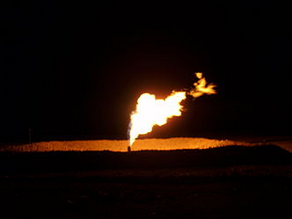 Methane has been estimated to be 80 times as potent a greenhouse gas as carbon dioxide on a 20 year time scale, and we're in the middle of positive climate feedback loops. Compact wind-powered sparking devices with small batteries could be inexpensively flaring off known Arctic point source methane releases, turning methane into carbon dioxide. This solution is affordable and it can be quickly implemented. We would want to worry about sparking tundra fires, but many methane releases are from lakes.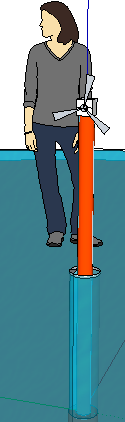
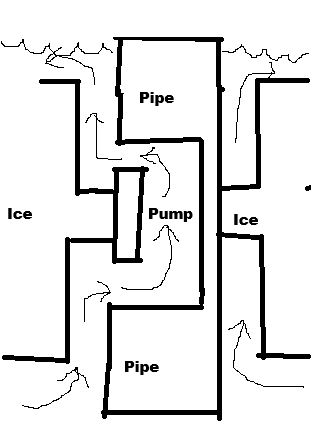 7/3/26 Air is an option for transmitting power down the pipe. Air doesn't freeze. The wind mill at the top would drive a series of gears which would turn a crank that pushes and pulls an accordian-like chamber. This sends air up and down a tube in the pipe. At the bottom of the pipe another accordion-like chamber expands and contracts to pull seawater in through a fine strainer mesh and one valve, then force it up and out through another valve. The lower part of the pipe will still need to melt itself free of the ice every so often. Heating wires can accomplish this.
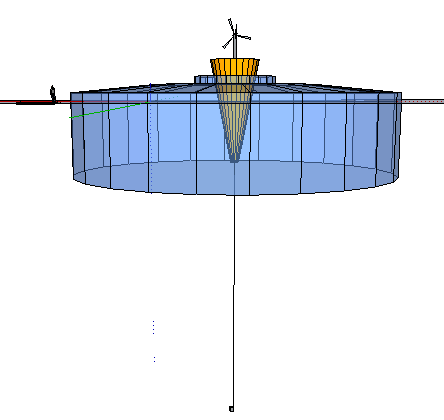 reated.
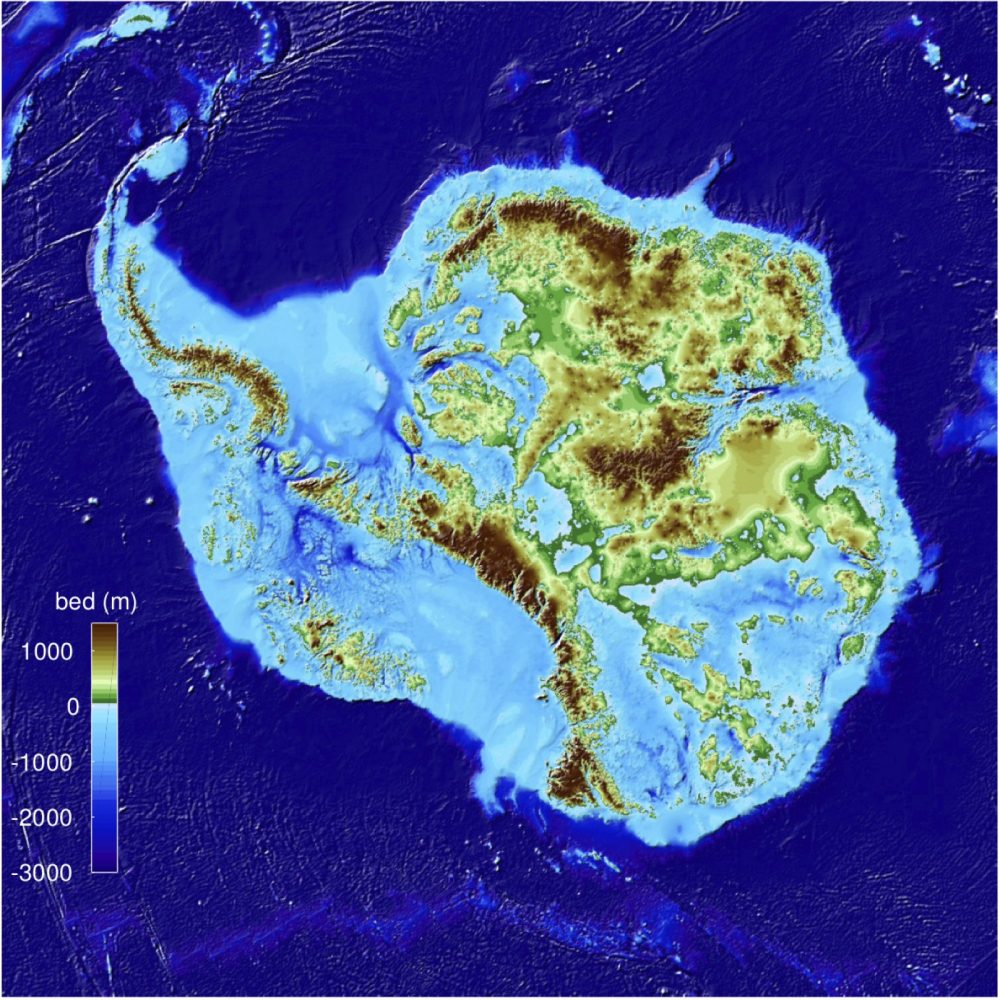 This satellite image of Antarctica shows which parts of the "continent" are actually below sea level once the ice sheet melts, and also if sea level doesn't rise 60 meters from the ice sheet melting into water. Right now relatively warm seawater is undercutting the West Antarctic Ice Sheet, that seabed area roughly below the Antarctic Peninsula mountain range in the satellite image..
 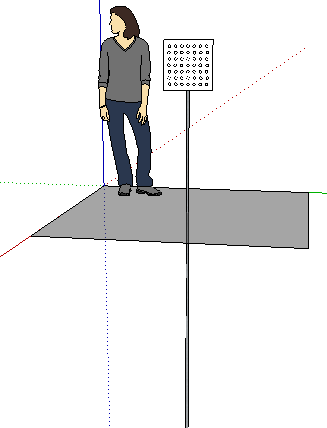 A simple non-moving metal coldness-transmitting spike or sharpened angle iron transmits the 40 degree below zero temperature of the Arctic winter deep into the tundra.